Showing posts with label abstract. Show all posts

Monday, September 15, 2014

Keeping current

It is a bother to keep current with the scientific literature. Everyone knows it is growing exponentially, although if you look at the new publication histograms on Pubmed they look rather linear. At least over the years after which most papers were actually submitted to Pubmed upon publication, i.e. 1990ies and later. If you pull out the number of publications per year on a given search, let us say "blood pressure" it looks like this:
It rises in fits and starts probably depending on how far back different journals have decided to back-register. If you look at the second graph there does seem to be a flattening of the curve in the sixties and onward indicating that the growth may be linear after all. Sadly, for blood pressure that means 18 000 articles per year as of 2014, and the rate increases with another thousand per year every three years. Working in several fields means trying to keep up with each of them, and makes for a grand total that does not bear thinking about.

Luckily the journals provide current contents feeds that one can read using a RSS. I used Google reader until that was cancelled and now I have moved to the brilliant service CommaFeed, which provides a very clean RSS-reader interface. Below is a screenshot of my current list of journal feeds.
With this kind of list you get a couple of hundred new publications every week, so there is no chance of reading all of them. What I do is skim the titles and selected abstracts in the reader, anything that appears interesting and relevant I will send to Papers to read more thoroughly. In addition, I regularly scan Pubmed for relevant articles, as you do when writing papers, grants, and lectures.

Wednesday, July 23, 2014

Pathophysiology of cardiorenal syndrome

Am I writing about actual science? Yes, apparently so. Thing is, the American Physiological Society has graciously decided that all corresponding authors of reviews and editorials would get 50 free reprints (useless), or a toll-free link (useful). However, in order to use said link you have to provide a specific URL of origin, wherein lies the problem. I don't trust the university to maintain my homepage anymore seeing as they just closed it down in favour of their new database-based system that I cannot do stuff with. So, this is the post where I will place the link.

The article was an invited review connected to an abstract sent to Experimental Biology 2014 in San Diego. It is basically a walk-through of how nervous and hormonal signalling affects kidney function in heart failure and thus contribute to the development of edema, and the worsening of both heart failure and kidney function in a vicious circle.

The title is: Renal neurohormonal regulation in heart failure decompensation, and it was written together with my present students Sofia, Mediha, and Jacqueline who are still in the lab, and Fredrik who have since moved on to his clinical internship.

For the time being you will have to make do with a (non-toll free) link to the article: LINK

Edit: Here is the toll-free link: Renal neurohormonal regulation in heart failure decompensation. By Sofia Jönsson (PhD-student), Mediha Becirovic Agic (PhD-student), Fredrik Narfström (MD-student), Jacqueline Melville (postdoc), and me.

Friday, July 12, 2013

Climbing to the top - Kidney Camp 2013

"Kidney" CAMP!

The FASEB Science Research Conference on "Renal Hemodynamics: Integrating with the nephron and beyond" took place last week at Vermont Academy in Saxton's River, VT. The meetings were previously called Summer Research Conferences, but they changed that to the quite strange "science research" that sounds more like a branch of philosophy to me.
Anyway, we still call it by its proper name: Summer Kidney Camp. It is a summer camp where spouses send their kidney physiologist halves to wear them out and enable at least a semblance of normal conversation during the rest of the summer. I'm guessing that doesn't work out as well as they hoped in much the same way as summer camp for kids don't.
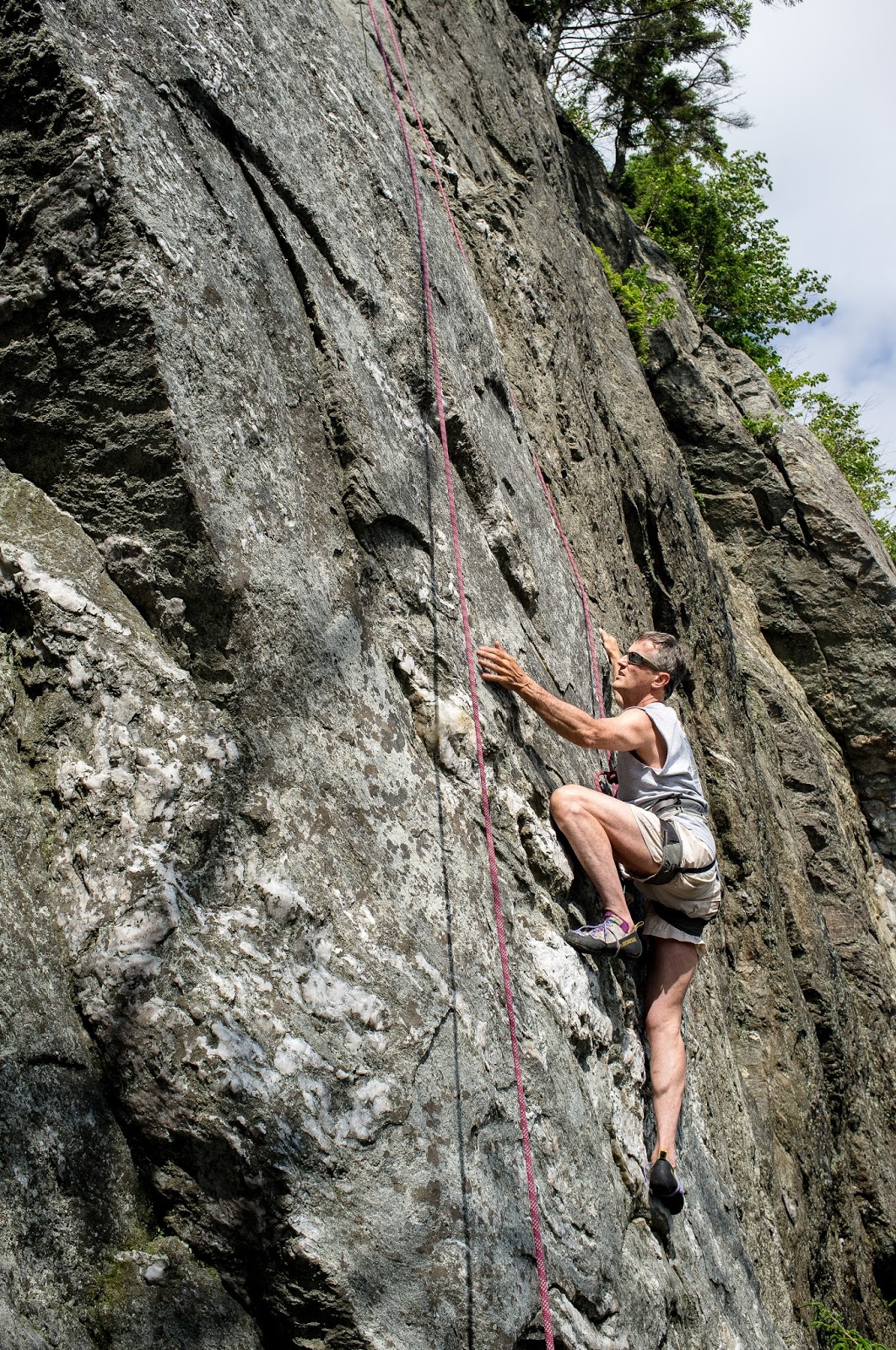
The Kidney Camp is held every three years, and has a tendency to return to Saxton's River, even if it has been held in other locations once or twice. The main feature is the afternoon-break where we do important sciency stuff, like sitting in the grass, playing softball, football (proper football), basketball, and top rope climbing (which, by the way, is awesome). As far as I can tell most attendees only play sports once every three years for reasons unknown to science, and quite dangerous to be honest. The climbing was probably the safest activity.
The evenings are filled with more science. The fiercely competitive talent show, which was won by one of the supporting acts. The collaborative table tennis, and the very novel fussball table (rumor has it the last one broke three years ago) where any argument can be settled with a well timed spinning of the rods.
Then we have billiards, which makes you look better, but only until you pop the cue-ball off the table. Aaron, who is posing for illustrative purposes only, never did. I promise. Honestly.
In between these important scientific sessions there were some other stuff, where a lot of actual science was actually discussed. Some six to eight hours of lectures per day, and the best poster session in the field. Not only because it is the poster session with a bar that serves local micro-brewery beer, but also because the bar keeps people at the posters and everyone, even invited speakers, bring posters. Luckily it is three years to the next meeting so that I, and my liver, can recover.

Thursday, December 15, 2011

Productivity in writing, and otherwise

I just read a wonderful post by writer Rachel Aaron (whom I haven't read anything by) about how she boosted her writing from 2000 words per day to over 10000. Yes, that is right, the equivalent of two articles per day. However, she is a novelist, not a scientist. What she suggests is that if you just try to make sure you have three things in place before you actually start writing, you can be much more productive.

Those things are:

  1. Know what you are going to write.
  2. Track how much you are writing.
  3. Get excited about what you are writing.
Sounds pretty straight forward. Number one is easy, there is a way you are supposed to write your articles. It is known as the IMRAD-format:
I ntroduction
M ethods
R esults
A well kept secret
D iscussion
Each of the sections have fairly well established patterns. Like the introduction:
Sentence describing a public ill. Sentence tying said ill to something vaguely connected with present study. Sentence about how present study is novel and interesting. 
New paragraph describing the actual background of the study. 
A paragraph describing what has actually been done. 
Final paragraph stating the aim and hypothesis of the study in a way that fits with the conclusion without giving it away.
The second point is more difficult. The end result of a day's writing may be a section of an article, say the abstract, that is 250 words. But in actuality you have probably written more like 1000 words, and thrown most of them away. So, given the word-limits of scientific articles, how do you track how much work you get done?

The third point is easy the first time, but then you re-write, submit, get refused, re-write, submit, get a revision, re-write, re-submit, get refused, rewrite... At some point here you aren't so excited anymore, and that is when you pick a bottom-line journal and submit one last time suggesting your best friends as reviewers.

 The strategy is also applicable to lab-work, teaching  and many other things.

  1. Know what you are going to do in the lab.
  2. Track how much you are getting done.
  3. Get excited about the work you do.
Anyway, I think her post is more well-written. You should read it.

Saturday, January 09, 2010

Saturday mix


Madicken going for the ball.

In Sweden it's very much a tradition that you're only allowed candy on Saturdays. There's a (or several probably) special bag of assorted sweets called Saturday mix. In honour of this staple of my childhood I'm going to post all sorts of shit here today.

Friday provided some really exciting new science. I was writing my abstract for ESH 2010 (to which you should go, deadline on Jan. 15th). When my pathologist (who I keep in a box) sent me a message on facebook and said that she had a surprise for me. Just then the abstract went from being a good abstract to being an exciting abstract. If you come to Oslo, I'll tell you (or show you on the poster).


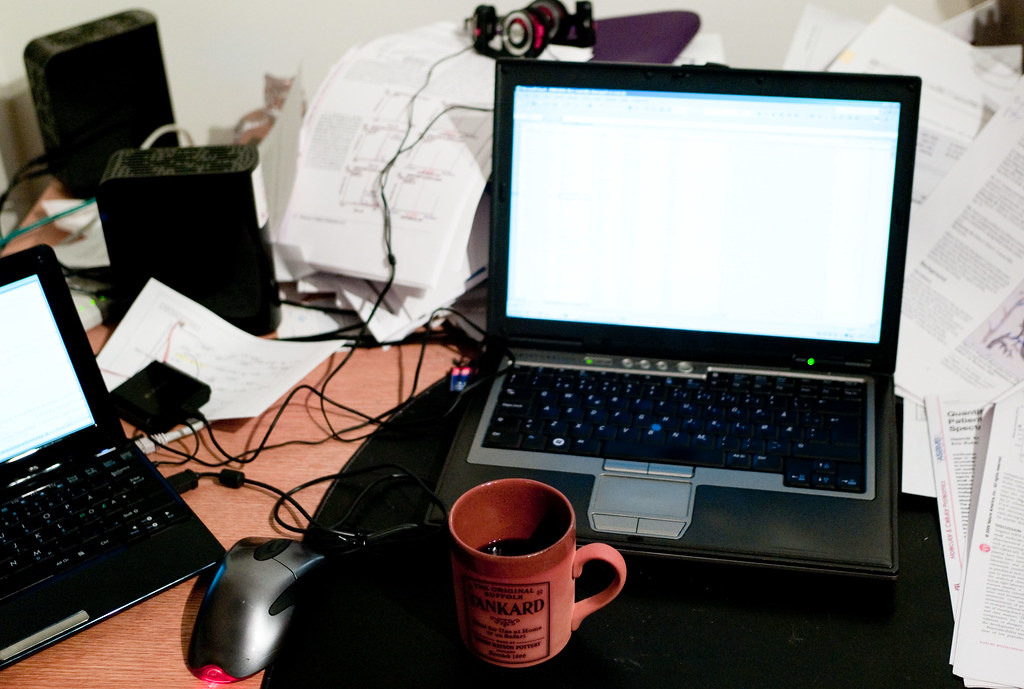
My desk at home as it looks when I am analysing data and writing abstracts all at once. It always looks like that but that just an ugly truth.

Then I had a really good chat with a post-doc from a lab where I would like to work. With some encouragement I sent an e-mail off, and lo and behold, got a swift and guardedly postitive answer from the PI.

So, today I'm in a good mood and fixed the first batch of pictures. They're not as good as I would like them, and I already missed two days, but they do make the blog prettier. I'm all for pretty blogs.


Madicken welcoming my fiancee back home.

Have a nice week end, don't eat too much candy, and remember to register for ESH2010.

Michael