Wednesday, September 01, 2010

Physiology on the sub-way map of science

By way of Chad Orzel and Derek Lowe I came upon Crispian Jago's wonderful sub-way map of science. While he actually presents his quite fantastic map as : "500 Years of Science, Reason & Critical Thinking via the medium of gross over simplification, dodgy demarcation, glaring omission and a very tiny font," I have to take umbrage for physicians and physiologists everywhere. Albrecht von Haller wasn't the only physiologist who did anything in the 18th century, and I think we existed, at least partially separate from "Natural History" in the 16th and 17th centuries. Above all, the science of Medicine certainly did not turn into "21st Century Microbiology!"

How, then, should this be put right?

Well, with a blog-post obviously. But first microbiologists deserve a line of their own, even if it will intersect with the line of medicine in quite a number of places. This is their problem. The medicine-line should be renamed "Medicine and Physiology", neurology is either a medical speciality or a branch of physiology. It could, of course, be argued that neuroscience/neurology/psychology should have a line of its own, but I leave that to the neuroscientists.

The freed-up line called "Medicine and Physiology" should start at Vesalius. Unless you want to go back to earlier times. Given the extent of the map, it may be wise to stop at the 16th century.

Hooke, Harvey, Malpighi and some others should be included on this new line. Now to the additions:

16th Century
  • Paracelsus (founding father of toxicology and early enlightened surgeon who suggested that wounds shouldn't be cauterised).
  • Bartolomeo Eustachi (One of the first anatomists, although his work wasn't published until 1714: Tabulae Anatomicae).
  • Ambroise Paré (1545: Wrote the first non-Latin/Greek textbook in surgery and was one of the original great experimentalists in surgery).

17th Century
  • Olof Rudbeck (1651: described the lymphatic circulation).
  • Lorenzo Bellini (1662: Exercitatio Anatomica de Structura Usu Renu).

18th Century
  • F. Pourfois du Petit (1727: shows vasodilation in the eye following denervation).
  • Stephen Hales (1733: Haemastatics).
  • Giovanni Mrogagni (1761: The seats and causes of disease).
  • John Hunter (1794: A treatise on blood, inflammation and gun-shot wounds).
  • Alexander Schulmansky (1783: De structura renum).

19th Century
  • Hanaoka Seishu (1804: first known use of anaesthesia).
  • Charles Bell (1811: sensory and motor nerves).
  • Richard Bright (1827: renal disease and oedema).
  • Jean Louis Marie Poiseulle (1828: measures blood pressure, 1841: fluid dynamics in small tubes).
  • William Bowman (1842: On the structure and use of the Malpighian body of the kidney).
  • Carl Ludwig (1842: describes glomerular filtration as physical forces).
  • Emil du Bois-Raymond (discovers the neural action-potential).
  • Adolf Fick (1855: describes law of diffusion that bears his name, and later used it to measure cardiac-output).
  • Karl von Vierordt (1855: measures the arterial pulse pressure).
  • Jakob Henle (1862:Described the loop of Henle's, and together with Robert Koch formulated the "Henle-Koch postulates").
  • William Gull (1872: microvascular disease).
  • Camillo Golgi (Described large parts of the nervous system and received the Nobel Prize in 1906. In addition he described how the distal tubule returns to the originating glomerulus, an important finding in kidney physiology).
  • Scipione Riva-Rocci (1896: Presented his method for measuring blood pressure, which is still used today).
  • Robert Tigerstedt (1898: showed the existence of Renin the first identified hormone).

20th Century
  • Victor Henri (1901: Describes the Henri-Michaelis-Menten equation for enzyme kinetics).
  • Leonor Michaelis and Maud Menten (1913: provides their insight on enzyme kinetics).
  • Ernest Starling (Describes the exchange of fluid over the capillary membrane in the Starling equation, then goes on to describe the Frank-Starling law of the heart, and then goes on to describe the idea of hormones).
  • Otto Frank (Describes the Frank-Starling law of the heart).
  • August Krogh (Treated diabetes with insulin).
  • Ewald Hering (1924: Discovered the baro-receptor and their role in blood pressure regulation).
  • Joseph Wearn & Alfred Richards(Establishes glomerular ultrafiltration as described by Carl Ludwig by micropuncture).
  • Werner Forssman (1929: performs the first human heart catheterisation, on himself).
  • Homer Smith (Describes the nephrons as autonomous working units in the kidney, and much more).
  • Harry Goldblatt (1934: Establishes the first experimental model of hypertension).
  • Arthur C. Guyton (1955: proposes that cardiac out-put is governed by periferal resistance, measures interstitial pressure and shows that it is negative, and goes on to show how the kidney regulates blood pressure).
  • Carl Gottschalk (1959: shows that the concentrating mechanism in the kidney is dependent on a counter-current system).
  • Edward D. Freis (1960: presents the first ever double blinded, controlled clinical trial).
  • Robert Furchgott (1980: Discovers the endothelial derived relaxing factor, and goes on to show that this is nitric oxide in 1986).

And then there are any number of still living physicians and physiologists who could be included.

Before it, in the end, turns into "21st Century Medicine and Physiology" and nothing else.

At least, that is the view of a nephrophysiologist. I know. There are physiologists and physicians who aren't into kidneys, but I always try to have hope: They will convert in the end.

Sunday, August 22, 2010

Glasgow, Venn-diagrams and The Festival


The Edinburgh Festival

In the spring, while trying to decide how to best prepare for my dissertation and the associated, short-prep-time trial-lecture, I had the great luck of being hunted down by one of the up and coming names in the functional genomics of hypertension. After my talk at the ESH meeting in Oslo, when I was heading directly to the air-port, Martin McBride ran me down to suggest that we should compare our data-sets. The result was that two weeks before my dissertation, just as the title of my trial-lecture had been announced, I went to Scotland for four days to work on something completely different.

Our data-set is from the mRNA expression profiling of old rats with hypertension and slow developing kidney damage, while his is from salt-challenged stroke prone spontaneously hypertensive rats that develop kidney damage very quickly. By combining these datasets we hoped to learn something about the common pathways for kidney damage in our different models.

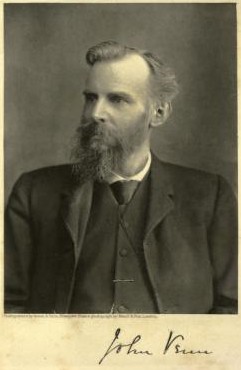
With Martins, and the Glasgow group's great experience with these kind of things we managed to get our data into comparable formats in just under four days. The next step was actually comparing the changed genes. To do this we basically want to check which genes popped up in both of our sets, an onerous task but one greatly simplified by the use of Venn-diagrams (John Venn FRS, Symbolic Logic, 1881).


John Venn FRS

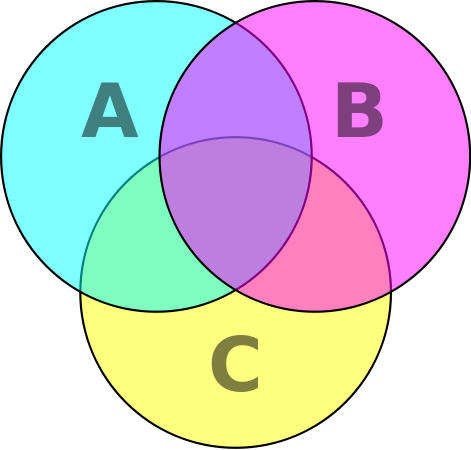
Basically you represent each data-set as an area, for example a circle, and by intersecting these you can illustrate the set of common items. We started with a simple online-tool that can make 2 to 4-way Venn diagrams. But soon progressed to running the comparisons in R with a little help from Glasgow statistician John McClure.


Venn-diagram

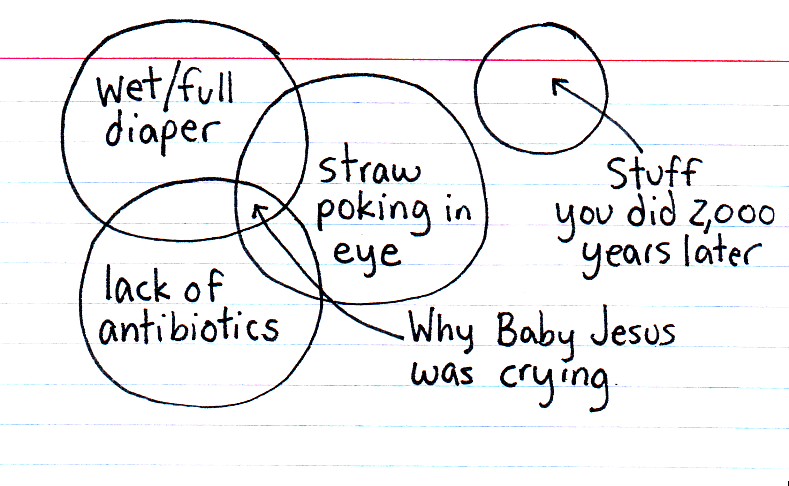
If you want more Venn-diagrams to look at you should visit Jessica Hagy at Indexed. Although, she has made a complete hash out of what makes baby Jesus cry.


Dog at The Festival

It was my first time in Scotland, so I made sure to try the black-pudding (innocuous), the haggis (spicy) and a number of local beer (nice). The most amazing timing was that I managed to be there during The Festival. It's a festival like many others, Edinburgh is completely full of tourists and local festival goers. The Scottish present it as The Festival, the one, the original, the only true festival of which all others are pale comparisons. In many ways they are right. It doesn't have the arranged feeling of many other festivals. The main happening is the Fringe, which is the thousands of performers that aren't part of the festival proper, but show up anyway.


The Fringe

Everyone should go, but since it is a popular thing, you need to book your hotel about a year in advance. If I only knew my schedule for next August, I would have booked mine already.

Saturday, August 14, 2010

Fillet of horse sous vide


It has been kind of hectic lately, finishing the thesis, preparing for the dissertation, getting a mortgage for buying a new place to live in Sweden, working full time in the cardiology department and revising two papers.

Anyway, my fiancée got a job on Wednesday and by Friday we had outbid the competition for our dream-apartment. Or, a nice apartment anyway. So, today we were celebrating. She brought a Veuve Clicqout Ponsardin from the air-port and I went to the butcher's and got a slice of horse's fillet.


Horse is a dark, game-like, meat. Like any red meat it shouldn't be cooked to harshly, and this was so tender that I accidentally put my thumb through it when I was preparing it. So, cooking with care was the order of the day.

I have been reading a lot Cooking Issues since I was made aware of it. It is a fantastic cooking blog, especially if you are scientifically minded. Anyway, they do sous vide (eng. under vacuum) cooking, which is slow cooking with a twist. You vacuum-pack your uncooked food and then cook it in a water-bath at the desired temperature (58 centigrade for medium rare beef) for an hour or two.


First, I seared it quickly with salt and pepper.


Since I don't have a vacuum-pump at home I just packed it in a plastic bag with red onions and garlic, sucked all the air out, and put it in a pot with water in the oven. The goal temperature is 58 centigrade for medium rare. Sadly my cooking thermometer is broken and the oven temperature dial is not as accurate as I would wish. Thus, I checked the temperature the old fashioned way, 58 is hot enough to hurt, but not scalding. I put a small weight on top to keep it under. It was allowed to cook for about two hours. Then I seared it once more and served directly.


The temperature wasn't exact enough and we ended up with a medium cooked piece of meat. It was a very tender, fantastically juicy and tasty piece of meat though. Any time now, I am going to buy a proper heater/circulator like the Sous vide professional, which is made especially for cooking sous vide. It does look very much like your standard scientific water-bath heater/circulator and that is because it is. Although, they have a prettier, black, casing for the cooking variant.


If you have meat, you need potatoes. In this case a spring potatoe & melon salad. The sweetness works fantastically with the dark horse-meat and the champagne.


For a sauce I made a classic reduction of assorted vegetables and the juices pressed out of the meat during cooking. I reused the root-vegetables to make a purée, nothing much by itself, but adds a nice extra texture to the meal.


Here are the vegetables, the rosemary and the juniper-berries before they were transformed into stock with the help of some gin and a lot of water.


And there we are: Horse-fillet sous vide with mashed celeriac and turnip. A potato and melon salad, sauce and champagne. I served it with a little balsamic syrup to add some acidity.

Thursday, July 22, 2010

The Contact Sheet


This is a photo-book from Ammo that was well received, at least in snowed-in photographer-circles. It combines a collection of very famous photographs with the contact-sheets they were picked out of.


A brief introduction of the contact-sheet for non-photographers and those who only ever used digital cameras, who might not have heard of it before. When shooting negative film, most photographers just do not have the ability to visualise the positive image when looking at the negative. So, what they do is place all the negatives from a roll of film directly on a piece of photo-paper and make print of that. It is called a contact-sheet because the negatives are in contact with the photographic paper.


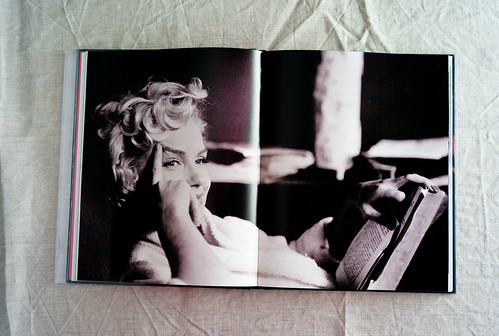
In the book each final print is paired with it's contact sheet. Shown above is Elliott Erwitt's photograph of Marilyn Monroe. You can see his selection process right on the contact sheet; marking the frames he likes and picking those to enlarge. Final selection would of course be made from the enlargements. As you see, the picture marked as "#1" wasn't the final pick.


I just wanted to show a 'contact sheet' from a large-format photographer too. Much of early large-format photography was only ever contact-copied, although it obviously holds up to much greater enlargements than 35mm does. But you get to see two alternative views of the famous photograph of "Case Study House #22".


Each photograph is accompanied by a brief biography of the photographer and an equally brief story about the photograph. In case you don't read the Queens, it is also provided in French, German and Spanish. It is a nicely bound book, with good quality paper and quite decent reproductions. Its main features are the range of photographers, 44 in total, and the insight into their work you get from seeing all the pictures they didn't pick.

Wednesday, July 21, 2010

Small Trades by Irving Penn


The well known Vogue photographer Irving Penn, didn't exclusivly shoot the famous, the pretty and the nude in the world of high fashion. From the beginning he was a still-life photographer. He did a large series of portraits of more common people with the implements of their trades. From the start it was a feature for Vogue about the workers of Paris, but he continued long after that. The entire series is 252 portraits and was bought by the Getty museum in 2008. The Getty is also the publisher of the book.


The book is quite hefty and very well made, with heavy, luxurious paper. In the beginning there is an example contact-sheet with some slight variations of the pose of the subject, and some pictures from the back. That way one can get an idea, if only a slight idea, how he worked. There is also a picture of his Paris studio with a large window on the wall and one in the ceiling. In addition, he has a reflector and a mottled back-drop, but that is it. It looks positively frugal by today's measure.


The pictures as such are reproduced in outstanding quality. They depict, apparently, comfortably posed workmen and women with one or two tell-tale tools that they use in their work.


It is a brilliant book for anyone interested in photography in general or in portraiture in any medium.

Julius Shulman in Modernism Rediscovered


I am in the middle of my one-week vacation. That means I try to do some photography. While trying to find some inspiration for doing that; I found some new (for me) photo-books. A perfect combination of activities becomes photographing photo-books and writing short reviews.


First out is Modernism Rediscovered, which is a book about the modernist movement in American architecture; And photographs by Julius Shulman. One of the big names in photography and one of the very best know architectural photographers ever. His probably best known picture is the "Case Study House #22, Los Angeles, 1960. Pierre Koenig, Architect." Which you can see below (It is from 'The Contact Sheet', another book that I will come to shortly):


I had of course seen his photos before, but it wasn't until recently I found out who took them. There is a film about his life and photography called 'Visual Acoustics'. It inspired me to set out to find a matching book. Luckily it turned out that Taschen has one. Not only do they have one, it has a special-price edition. Very affordable. Very high quality. Very good reproductions.


And if you are interested in architecture as such, there seems to be a wealth of information in the text. =)

More to come.

/Michael

Wednesday, July 07, 2010

Treatment-targets in hypertension

We have to congratulate Rhonda Cooper-DeHoff and her co-authors on their recent article in the Journal of the American Medical Association on: "Tight blood pressure control and cardiovascular outcomes among hypertensive patients with diabetes and coronary artery disease" reporting a sub-group analysis from the INVEST study.

This adds another sub-group analysis to the long discussion about the "J"-curve found in blood pressure vs. cardiovascular out-comes in hypertension studies. See, for example, this review by Alberto Zanchetti and co-workers from 2009. Similar results were found in the ONTARGET and VALUE and TNT trials. In all these trials the risk of a cardiovascular end-point starts to increase when pressure goes below 120 mmHg. Which also holds true for the INVEST trial. One important new point is that in the INVEST trial the all-cause-mortality - the first among equals of end-points - also increases with lowered systolic blood pressure. Although it is only significantly increased at pressures lower than 110 mmHg the trend is increasing already from 130 mmHg.

An important point is that all these trials concern the treatment of high risk patients. An untreated systolic blood pressure between 120 and 130 mmHg is rather considered pre-hypertension and is associated with increased risk, and will probably be indicated for treatment once the proper trials have been done. However, if you are a patient with hypertension, diabetes and coronary artery disease there is more and more evidence indicating that your pressure should be lowered with moderation.

What the field still lacks is a randomised controlled study where patients are randomised to either systolic blood pressure below 130 mmHg or between 130 and 140 mmHg. Before that there is no certain way of distinguishing the ability to get below 130mmHg from the intent to lower blood pressure below 130mmHg. That is, if there are, for example, a population of more pressure-labile patients that are at higher risk or if there is some other uncontrolled reason for this larger risk.

While some guidelines are lagging a little, the core result was known at least a year ago, and is reflected in the 2009 guidelines from the European Society of Hypertension where the target for diabetic patients have been adjusted upwards to higher than 130 and lower than 140 mmHg.

The next question is: "Why is this so?"

What happens with in high risk patients with serious co-morbidities that makes them vulnerable to aggressive lowering of blood pressure? I think it has to do partly with changes in the microvasculature that adapts the circulatory system to higher pressures, i.e. remodeling and hypertrophy; and partly with end-organ damage in the form of fibrosis and reduced capillary density making an increased capillary pressure important for a sufficient fluid and nutrient exchange over the capillary walls.