Having properly started my residency in anaesthesiology and intensive care medicine I have started looking for textbooks to help me.
In my view medicine has four important levels of knowledge: basic science, clinical practice, evidence based medicine, and epidemiology. Clinical practice will be the focus of your general textbook, but each level deserves its own book because the general textbooks are never good enough. For basic science and EBM the demand for detail and precision is much greater, and epidemiology is often ignored completely.
What follows will be a number of book-reviews of books that I have read, which are useful for anaesthesiology residents. If you have any suggestions, please leave a comment.
So far I have these three general anaesthesia books, which I will say something about.
Morgan & Mikhail's Clinical Anesthesiology (2013, 5 ed. edited by John F. Butterworth IV, David C. Mackey and John D. Wasnick), which is actually available in electronic form through the university library. It's an easy read, unless you are easily annoyed by typos and trivial errors. Instead of references it has suggested reading, which is a mix of reviews, book-chapters and original research. To say that it lacks depth is to state the obvious, but it seems to reflect the state of clinical anaesthesia fairly well.
With that I mean that there is sufficiently scarce evidence that the personal opinion and experience of the individual mentor makes huge differences in how and what you are taught. It is a bit annoying, because you spend a couple of weeks with one specialist behind you, until they are confident to let you run things. Then you change to the next specialist, and they basically think you are insane.
Anestesi (2005, 2 ed. edited by Matts Halldin and Sten Lindahl), a swedish textbook, which is helpful for some practices that are more specifically swedish, and it is generally a good book. Not very thick though, so rather basic.
Anestesikompendium (2004, 8 ed. edited by Rainer Dörenberg), the pocket reference produced by the department in Uppsala. It's brilliant for working in Uppsala for obvious reasons, and includes important practical knowledge like which syringes to use for which drugs, and pre- and postoperative guidelines for different operations and different post-op wards at the hospital.
This early in the residency I am in a read and re-read mode for trying to remember and understand the different anaesthetic regimens and why different specialists prefer different ways of doing things, so it is a good thing to have a couple of books to compare. However, in many cases where practice is significantly different between different specialists they give no, or little guidance, which is why I am seriously considering getting a more complete work. Like 500 pages thicker Clinical Anesthesia by Barash and coauthors, or the two-volume over three thousand pages thick Miller's Anesthesia. In addition there are more specific books covering specific subfields of which I will write more later when I have had time to read them.
Showing posts with label books. Show all posts
Showing posts with label books. Show all posts
Monday, August 05, 2013


Wednesday, July 17, 2013
A matter of questionable importance

One of the most important aspects of reading is to have a good place to read. Crazy, you say. Any place is a good place to read, and of course you are right. When I was younger I would read all the time and everywhere, walking around bumping into people, missing my bus-stops, and getting reprimanded in class. Indeed every place was a good place to read, but now it's different. Wherever I find myself I have somewhere else I should be, or I have something that more or less urgently needs to get done. So when at home, when at rest, a special place to sit and read and think is an important thing. A place of solace (A fortress of solitude! No, too much?).
It is obviously not as important as roof over your head or food and clean water, but important never the less. For years I haven't had one, and I haven't read as much as I used to. It has simply not been a priority when furnishing the flat.
Anyway, we were at IKEA the other day and there was this new armchair model. Simple, not overly large, really cheap, and above all with side head-rests. I had to have it. There have been a number of armchairs I have had to have over the years, but since this was simple, small and cheap I could buy it on impulse. Now I have the ideal reading corner, and it complements my life-sized decorative boxer perfectly. It is close to my books, but not the work books, and it is far away from the computer and the heaps of manuscripts, applications and statistical analyses to be worked on.
I do have a small confession to make. I am writing this in said chair, and I did just check my mail, but then rules are made to be broken. Especially small silly rules with no real fundamental importance. Anyway, there shan't be too much work done here, and I shall honestly try to get some reading done real soon now.
Saturday, November 17, 2012
Dogphotobooks
There are an insane number of pet pictures on the internet and there seems to be another book of puppies every other day, but when you like photography, books, and dogs you have to try to find something worthwhile. First in line is a thick thing that at a distance looks like any other book of puppies, but isn't. The Taschen published A thousand dogs is a thick (yes, Thick), soft-bound thing with 1000 (I assume) photographs of dogs.

However, instead of a collection of the 1000 currently cutest and cheapest pictures they could find they have collected a comprehensive historical selection of dog photographs. From 1839 and forward. The first are simple posed photographs made with some of the first cameras ever made, clearly showing the central role of dogs in our society across the years.

The book is divided into sections by years and includes some quite well-known photographers and photophraphs. The reproductions are quite good, at least matching the quality of the binding. It is a an interesting book both as a history of photography and for the wealth of images (of dogs), some of which are quite good.

Second out is the leading photographer of posed dogs, William Wegman. He has produced a number of books with his Weimaraner dogs. I picked the book Polaroids with pictures from an impressive 20x24in large-format camera.

Some are more or less silly Weimaraners in clothes, but some are exquisitely posed humanesque dog photos. Let me just say that these are nor pictures you could make with boxers. No boxer I ever met would stand still matching paws with another boxer posing as it's shadow. At least not for long enough to make a large-format photograph.


Another book of posed dogs is Tim Flach's Dogs Gods. It is what we in Sweden call "praktverk", no expense has been spared. The binding is excellent, the format is non-standard. There are different high-quality photos on the binding and the dust-jacket. The reproductions are among the best available for large-production colour printing.

It is not quite as luscious, and not nearly as varied or complete as his book about horses Equus. Almost all photos are carefully posed and lit images. With only a few natural light - natural behaviour images sprinkled on top.

As with Equus there are some images that by their setting must have been taken in the wild but with lighting and posing that are nothing short of miraculous. Among dogphotobooks, this is the most equal of them all.

The nestor of dog-photography is Magnum's Elliot Erwitt. Elliot Erwitt's Dogs is a new collection of some of his most iconic dog photographs, as well as a number less well-known pictures. It includes a foreword in English, German, French, Spanish and Italian (as any proper book should). Elliot Erwitt represents the opposite of Wegman and Flach in that the book is all black and white, and while there are some studio shots the vast majority of photographs are of dogs doing what dogs do. They are ungroomed, sniffing each other, licking themselves or just taking a piss. If they are posed it is just the look-at-the-camera pose, or, they might be barked at. Something Erwitt is known for doing.


Saturday, October 27, 2012
Polar Obsession

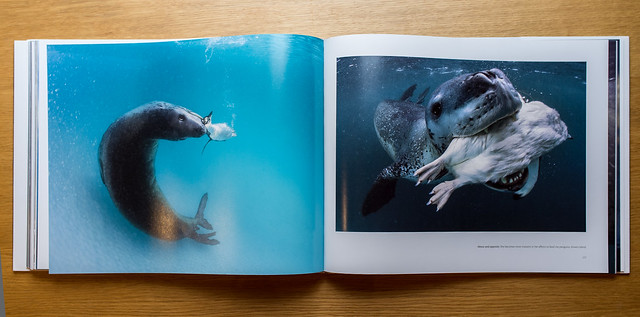
However, I don't have the book as such yet, so this time it is Polar Obsession by Paul Nicklen. It is published by the National Geographic, and is absolutely stunning. Good format, slightly squat and not too large for having in one's knee. It is however to large for hand-holding. The binding and the paper quality are excellent and the reproductions are really nice.
Tuesday, July 05, 2011
Advice for a Young Investigator
Santiago Ramón y Cajal was a 19th century neurophysiologist. I'm told he is well known, though he seems to have ignored the kidneys completely. Strange.
Any way, he wrote a book - "Reglas y consejos sobre investigacion cientifica" translated as "Advice for a Young Investigator" - to help budding scientists through their first years as researchers. While some of his advice is dated, such as the section on how to choose a wife, most is well worth the $14. What follows is a brief summary and some comments on the 1999 MIT Press pocket edition (with one of the worst quality bindings in modern history), translated by Swanson and Swanson (who have done a good job).
There is a Foreword by Larry W. Swanson with a short biography of Dr. Cajal and some suggested readings from his quite large production. Then there are three prefaces, for each of the second, third and fourth editions.
There are nine chapters, each addressing a different potential difficulty.
1. Introduction
The introduction concerns itself with which theory of science a scientist should build his understanding of nature upon. The answer is determinism. Cajal is very clear that a scientist should not spend his time delving too deeply into the various theories of knowledge and science. He writes:
"...by abandoning the ethereal realm of philosophical principles and abstract methods we can descend to the solid ground of experimental science..."In this he comes quite close to my own thoughts on the matter (which may be why I like the book in the first place). Today, pure determinism is still usefully utilized in Chaos Theory, or the study of non-linear dynamics, but in general the focus today should be on statistical determinism. That is, the fact that we cannot know the full state of any system (at least any interesting system) induces variation and that this punches a quite large hole in classical determinism, but can be compensated for by studying larger populations and using statistics. Actually Cajal does not mention statistics at all, probably because it was just starting out as a field at the time.
2. Beginner's Traps
In the second chapter Cajal goes through some things that might unduly discourage the beginning scientist from his chosen path. Basically that well known feeling that those who went before were smarter, saw farther and thought deeper than you ever could. He makes the case that it only seems so after the fact, and that with hard work and time a scientist starting out today will appear equally daunting to those starting out in the future.
3. Intellectual Qualities
Cajal's main point about the mind of the investigator is that it does not have to be exceedingly brilliant as long as it is tenacious and a bit vain. He does mention originality, but his focus really is on hard work and the striving for glory. These are qualities he dejectedly notes are none too present in his contemporary Spaniards, while he holds the Germans in high regard. He writes:
"In Spain, where laziness is a religion rather than a vice, there is little appreciation for how the ... work of German [scientists] is accomplished - espeially when it would appear that the time required ... might involve decades!"
Rather poignantly, the endnotes have been expanded with the editions. In relation to a section written in the original 1893 edition Cajal later notes:
"This frank optimism is now greatly undermined by the hideous international war that began in 1914... It is sad to admit, but all nations become ferociously imperialistic as soon as possible... So much for the weak and unpatriotic!"
4. What Newcomers to Biological Research Should Know
In this chapter Cajal handles the opposing needs for the investigator to know a lot about disparate fields, especially the basic sciences, and at the same time specialize as much as possible to be able to produce original work.
Perhaps his most important point is the short section on "Mastery of Technique", as he writes:
"...the most important scientific conquests have been won by only a dozen men who have become known for their invention of improvement of a research method..."
5. Diseases of the Will
This is clearly the most entertaining section. The six most dangerous personalities - "who never produce any original work and almost never write anything." - are described in detail. I will only quote the his classification, the rest you should read in his original, quite wonderful prose.
"These illustrious failures may be classified in the following way: the dilettantes of contemplators; the erudite or bibliophiles; the instrument addicts; the megalomaniacs; the misfits; and the theory builders."
While these are quite fun, and you can always find some colleague that fits each personality, the more important lesson is that everyone gets trapped in these mires of the mind from time to time. The important thing is to realise that you are stuck in an unproductive mindset and be able to move on.
6. Social Factors Beneficial to Scientific Work
These are the ever current problems of funding, combining a profession with science and combining work and family. His basic stance is that you can always do science, but you should be ready to sacrifice having a life. Good advice.
7. Stages of Scientific Research
Here Cajal goes over the practicalities of the experimental method. Observation - Experimentation - Working hypotheses - and Proof. It is material gone over many times in other books, although Cajal has the benefit of being brief.
8. On Writing Scientific Papers
To start with Cajal references a Mr. Billings and states four rules: Have something to say; Say it; and Stop once it is said. The fourth rule wasn't as catchy so I'll just drop it. Then he writes a bit about credit and curtesy.
9. The Investigator as Teacher
The final chapter expounds on the importance of fostering future researchers to continue the work once you have gone. He concedes that it might be restful and rewarding to work in solitude but that "Posterity has always been generous with the founders of schools." He then goes on to describe the pains and pleasures of trying to combine research and teaching. First, how to find a suitable potential investigator; then how to guide him; and finally how to see him become a successful scientist leave science for profit and glory.
In conclusion, it is one of the few books that actually describes what it means to be a scientist, specifically a physiologist. It is certainly one of the very, very few that does so while being well written. I heartily recommend it to all my colleagues, and to any one else who might be interested in what science really is.
Thursday, July 22, 2010
The Contact Sheet

This is a photo-book from Ammo that was well received, at least in snowed-in photographer-circles. It combines a collection of very famous photographs with the contact-sheets they were picked out of.

A brief introduction of the contact-sheet for non-photographers and those who only ever used digital cameras, who might not have heard of it before. When shooting negative film, most photographers just do not have the ability to visualise the positive image when looking at the negative. So, what they do is place all the negatives from a roll of film directly on a piece of photo-paper and make print of that. It is called a contact-sheet because the negatives are in contact with the photographic paper.
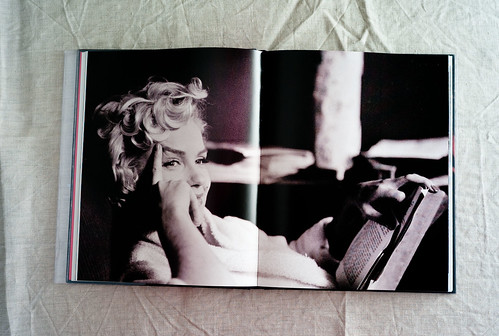
In the book each final print is paired with it's contact sheet. Shown above is Elliott Erwitt's photograph of Marilyn Monroe. You can see his selection process right on the contact sheet; marking the frames he likes and picking those to enlarge. Final selection would of course be made from the enlargements. As you see, the picture marked as "#1" wasn't the final pick.

I just wanted to show a 'contact sheet' from a large-format photographer too. Much of early large-format photography was only ever contact-copied, although it obviously holds up to much greater enlargements than 35mm does. But you get to see two alternative views of the famous photograph of "Case Study House #22".

Each photograph is accompanied by a brief biography of the photographer and an equally brief story about the photograph. In case you don't read the Queens, it is also provided in French, German and Spanish. It is a nicely bound book, with good quality paper and quite decent reproductions. Its main features are the range of photographers, 44 in total, and the insight into their work you get from seeing all the pictures they didn't pick.
Wednesday, July 21, 2010
Small Trades by Irving Penn

The well known Vogue photographer Irving Penn, didn't exclusivly shoot the famous, the pretty and the nude in the world of high fashion. From the beginning he was a still-life photographer. He did a large series of portraits of more common people with the implements of their trades. From the start it was a feature for Vogue about the workers of Paris, but he continued long after that. The entire series is 252 portraits and was bought by the Getty museum in 2008. The Getty is also the publisher of the book.

The book is quite hefty and very well made, with heavy, luxurious paper. In the beginning there is an example contact-sheet with some slight variations of the pose of the subject, and some pictures from the back. That way one can get an idea, if only a slight idea, how he worked. There is also a picture of his Paris studio with a large window on the wall and one in the ceiling. In addition, he has a reflector and a mottled back-drop, but that is it. It looks positively frugal by today's measure.

The pictures as such are reproduced in outstanding quality. They depict, apparently, comfortably posed workmen and women with one or two tell-tale tools that they use in their work.

It is a brilliant book for anyone interested in photography in general or in portraiture in any medium.
Julius Shulman in Modernism Rediscovered

I am in the middle of my one-week vacation. That means I try to do some photography. While trying to find some inspiration for doing that; I found some new (for me) photo-books. A perfect combination of activities becomes photographing photo-books and writing short reviews.

First out is Modernism Rediscovered, which is a book about the modernist movement in American architecture; And photographs by Julius Shulman. One of the big names in photography and one of the very best know architectural photographers ever. His probably best known picture is the "Case Study House #22, Los Angeles, 1960. Pierre Koenig, Architect." Which you can see below (It is from 'The Contact Sheet', another book that I will come to shortly):
I had of course seen his photos before, but it wasn't until recently I found out who took them. There is a film about his life and photography called 'Visual Acoustics'. It inspired me to set out to find a matching book. Luckily it turned out that Taschen has one. Not only do they have one, it has a special-price edition. Very affordable. Very high quality. Very good reproductions.

And if you are interested in architecture as such, there seems to be a wealth of information in the text. =)
More to come.
/Michael
Subscribe to:
Posts (Atom)


