Showing posts with label review. Show all posts

Saturday, March 07, 2015

Meta analysis in R

or 

the beneficial effect of teaching on research

I have been fascinated by meta analysis for a long time. It is so obviously the right way to approach the true effect of an intervention. Recently, an old binder presented itself in a pile of shite bunch papers I meant to read but found myself throwing in the bin tidying away. It contained the draft of a database of physiological data from the first years of my PhD. The idea was to compare all the baseline data from our kidney research group in Uppsala to look at the effect of the models as such and the interventions that were used repeatedly. With the insight of the intervening years it seems a lot less interesting now, but I still have the feeling that some areas of experimental research could benefit from meta analysis.

Which brings us to the the story I am about to tell. Four or five years ago, when I moved back to Uppsala, I got offered a lecture on physiological changes in the elderly. It was to be part of a final year course for the master in biomedicine programme. Just a single hour to show how all the physiology from the rest of the programme changed with age. To compare and contrast ageing as such with the accrued ailments of living for a long time, and distinguish these from the chronic and age related disease. It was not a huge success, but given the title I was not too disillusioned. The second year I was given two hours. Still a bit on the short side, but one hundred percent better than one.

It is not the most popular lecture, but I have had it for five years now and one of the things I teach is that some parts of ageing is caused by metabolism itself. The burning of oxygen singes the organism and with time it will break much like the paneling in an old sauna. As proof of this I used the idea of caloric restriction, which can prolong life in many strains of yeast, mice, and rats. Then, in 2012 an article was published on the effect of caloric restriction in the Rhesus monkey, a primate, and reasonably the closest relative to humans in which an experiment could be expected to be finished any time soon. It showed no effect. I happily included this in my lecture as a counter-point. Until in 2014, when updating the lecture for a new semester, I found that another experiment with caloric restriction in Rhesus monkeys had published their data and found a clear difference.

This made it hard to continue the lecture as I had done, I could just show both studies and say that we don't know. But the total number of animals included was quite large, and the effect measure very straight-forward. Death. So, I performed a meta analysis of mortality of these two studies, and a third smaller study published in 2003. This is the story of that analysis.

Quickly I installed the R package rmeta by Thomas Lumley and set to work. It is quite easy really, we start with setting up a table of results from the included studies. The table should include the total number of subjects in each group, and the number of deaths per group.

Hultström, M. Acta Physiol (Oxf). 2015 Feb 14. doi: 10.1111/apha.12468.
The we push this trough the rmeta function meta.MH(). To get a forest plot, we just run the plot() command, which has a default for handling the result of meta.MH() in the form of a forest plot. If you have a larger meta analysis there is also the funnelplot() that can be used to assess publication bias. Anyway, the result is quick and easily understood, which is really one of the major strengths of the forest plot.

Hultström, M. Acta Physiol (Oxf). 2015 Feb 14. doi: 10.1111/apha.12468.
There was no significant effect of caloric restriction on all cause mortality in Rhesus monkeys. Or, rather there was a small, clearly non-significant, effect. One of the reviewers asked what would be needed to show if this effect was true. That is, could I please perform a power analysis. So, I installed the pwr package and ran a 2p2n.test() using the most generous effect estimate, i.e. a hypothetical study that ran to completion where the whole control population had died giving an effect of 0.08. This resulted in a required population of 2806 subjects to reach 85% power. This is the power-level which is normally used as the basis for power calculation in clinical studies. However, the age-related mortality was a different story that you can find in the actual article.

The next thing that surprised me was how difficult it was to get this simple little analysis published. It appears that experimental journals don't publish meta analyses, and clinical journals that publish meta analyses, don't publish experimental results. Finally, I found a benevolent editor at Acta Physiologica who permitted it to be published as an editorial. So that is where it resides today, and finally I can give a fairly clear answer in my lecture on the effect of reducing metabolism by caloric restriction on ageing and on mortality. Only problem is, I now have to explain meta analysis and forest plots before I can show the actual data.

And, no I am not going to starve myself so that I can avoid some diseases we can treat in favour for a frailty for which the only known treatment is eating more.

Sunday, January 04, 2015

Fujifilm X100T first impressions

My Fujifilm X100T arrived on January 2nd so I have had all of two days to try it out. A while back I wrote a list of what I would like to see in the X100S replacement that was anticipated for Foto Kina. There were nine items on the list and most have been fulfilled, or at least significantly improved with X100T.
1. The burst mode does not lock the camera so it is possible to take another burst almost directly. 
2. There is a setting for release priority, and it is separate for continuous and single shot focus so that you can have one for each. 
3. There is no tab on the focus wheel, nor is there always-on manual focus. However, the manual focus is excellent with split-screen, peaking, and 100%-preview modes. 
4, 6, 7, & 8. While there are no dedicated switches, there is a drive-mode button for selecting single, continuous, bracketing, or film mode, and there are seven programmable buttons that I have programmed to cover my needs. 
5. There is no dedicated ISO dial. Although, I have high hopes for a firmware update that lets you use the exposure-compensation dial for ISO. It should be easy, really
9. While there is no touch screen, the buttons are much better with a dedicated back button to get out of menus.
As you see, it still does not have a manual ISO dial, but otherwise I am happy. It is a massive improvement above the X100, which, given how much I liked the X100, is no idle praise. The film simulation is particularly useful when working in black and white, I have the camera set that way and have Adobe Lightroom set up to import as low-contrast black and white. It works excellently. High ISO is excellent up to 6400. I haven't had use for higher ISO seeing as I am only in Sweden in January, and not in a mine. Macro shooting also works well, at f2 the actual focus seems to lie slightly in front of the apparent focus using peaking manual focus, and autofocus is not the most accurate. Honestly, f2, autofocus, and macro are three things that don't generally go together. So, I can't really fault the camera for that.

Here are some examples from the first days of shooting. As you see it works right out of the box for boxer snaps.

With a little bit of thought it can take quite nice portraits.


And night-time shooting at ISO 6400 is no problem and gives very presentable result.


Monday, August 05, 2013

Books for anaesthesiology - General textbooks

Having properly started my residency in anaesthesiology and intensive care medicine I have started looking for textbooks to help me.

In my view medicine has four important levels of knowledge: basic science, clinical practice, evidence based medicine, and epidemiology. Clinical practice will be the focus of your general textbook, but each level deserves its own book because the general textbooks are never good enough. For basic science and EBM the demand for detail and precision is much greater, and epidemiology is often ignored completely.

What follows will be a number of book-reviews of books that I have read, which are useful for anaesthesiology residents. If you have any suggestions, please leave a comment.

So far I have these three general anaesthesia books, which I will say something about.

Morgan & Mikhail's Clinical Anesthesiology (2013, 5 ed. edited by John F. Butterworth IV, David C. Mackey and John D. Wasnick), which is actually available in electronic form through the university library. It's an easy read, unless you are easily annoyed by typos and trivial errors. Instead of references it has suggested reading, which is a mix of reviews, book-chapters and original research. To say that it lacks depth is to state the obvious, but it seems to reflect the state of clinical anaesthesia fairly well.

With that I mean that there is sufficiently scarce evidence that the personal opinion and experience of the individual mentor makes huge differences in how and what you are taught. It is a bit annoying, because you spend a couple of weeks with one specialist behind you, until they are confident to let you run things. Then you change to the next specialist, and they basically think you are insane.

Anestesi (2005, 2 ed. edited by Matts Halldin and Sten Lindahl), a swedish textbook, which is helpful for some practices that are more specifically swedish, and it is generally a good book. Not very thick though, so rather basic.

Anestesikompendium (2004, 8 ed. edited by Rainer Dörenberg), the pocket reference produced by the department in Uppsala. It's brilliant for working in Uppsala for obvious reasons, and includes important practical knowledge like which syringes to use for which drugs, and pre- and postoperative guidelines for different operations and different post-op wards at the hospital.

This early in the residency I am in a read and re-read mode for trying to remember and understand the different anaesthetic regimens and why different specialists prefer different ways of doing things, so it is a good thing to have a couple of books to compare. However, in many cases where practice is significantly different between different specialists they give no, or little guidance, which is why I am seriously considering getting a more complete work. Like 500 pages thicker Clinical Anesthesia by Barash and coauthors, or the two-volume over three thousand pages thick Miller's Anesthesia. In addition there are more specific books covering specific subfields of which I will write more later when I have had time to read them.

Saturday, October 27, 2012

Polar Obsession

Photobook review time! I just bought a new photobook: Edward Weston, Life Work offered as a special deal on The Online Photographer. It is the most expensive book I ever bought. No sorry, it is the most expensive non-work-related book I ever bought. Anyway, two days after the offer started the book sold out, now there are only some Special Edition books left.

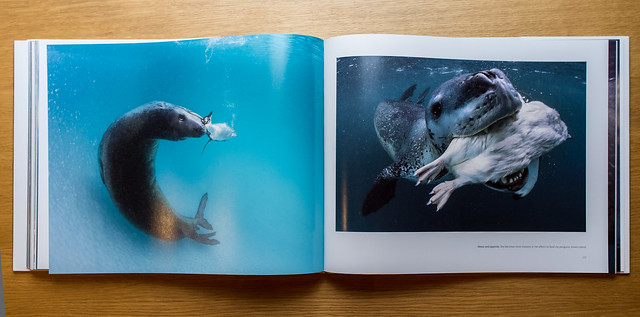
However, I don't have the book as such yet, so this time it is Polar Obsession by Paul Nicklen. It is published by the National Geographic, and is absolutely stunning. Good format, slightly squat and not too large for having in one's knee. It is however to large for hand-holding. The binding and the paper quality are excellent and the reproductions are really nice.
There are a huge number of these amazing photographs accompanied by fascinating little stories. Like one about a female leopard seal that tried to feed him penguins. But don't read it here, listen to him tell the story himself:
This is really one of my best photobooks, and it wasn't even that expensive.

Sunday, October 14, 2012

That third reviewer and the quality of your research

An interesting piece of meta-research has been circulating recently: Papers that have been refused and resubmitted receive more citations than papers that are accepted as is. This may appear counterintuitive or self-evident depending on your point of view.

It appears counterintuitive for non-scientists because it is easy to think that most of what gets refused is low-quality research. However, I would posit that authors are actually quite good at picking the right journal for their work, and get refused for other reasons than the over all scientific quality. This is where it seems self-evident. If authors are good at picking journals, then papers get refused because of insufficient supporting data. If, in addition, the quality is good this means that the reviewers find the results highly interesting. So interesting in fact that they would like more data to be really certain that the conclusions are correct.

This would certainly fit with the result of Calcagno and co-workers' findings that these previously refused articles are more highly cited. On top of that, a refusal generally includes reviewer comments and suggestions that pin-point the weaknesses of the work as seen from the outside. This often means that the authors will add even more data before resubmitting, and may then choose a higher impact journal as was indicated by the finding that the highest impact journals actually were more likely to accept articles that had been rejected elsewhere first.

There is of course still the possibility that the third reviewer is being an ass.

Tuesday, July 05, 2011

Advice for a Young Investigator

Santiago Ramón y Cajal was a 19th century neurophysiologist. I'm told he is well known, though he seems to have ignored the kidneys completely. Strange.

Any way, he wrote a book - "Reglas y consejos sobre investigacion cientifica" translated as "Advice for a Young Investigator" - to help budding scientists through their first years as researchers. While some of his advice is dated, such as the section on how to choose a wife, most is well worth the $14. What follows is a brief summary and some comments on the 1999 MIT Press pocket edition (with one of the worst quality bindings in modern history), translated by Swanson and Swanson (who have done a good job).

There is a Foreword by Larry W. Swanson with a short biography of Dr. Cajal and some suggested readings from his quite large production. Then there are three prefaces, for each of the second, third and fourth editions.

There are nine chapters, each addressing a different potential difficulty.

1. Introduction
The introduction concerns itself with which theory of science a scientist should build his understanding of nature upon. The answer is determinism. Cajal is very clear that a scientist should not spend his time delving too deeply into the various theories of knowledge and science. He writes:
"...by abandoning the ethereal realm of philosophical principles and abstract methods we can descend to the solid ground of experimental science..."
In this he comes quite close to my own thoughts on the matter (which may be why I like the book in the first place). Today, pure determinism is still usefully utilized in Chaos Theory, or the study of non-linear dynamics, but in general the focus today should be on statistical determinism. That is, the fact that we cannot know the full state of any system (at least any interesting system) induces variation and that this punches a quite large hole in classical determinism, but can be compensated for by studying larger populations and using statistics. Actually Cajal does not mention statistics at all, probably because it was just starting out as a field at the time.

2. Beginner's Traps
In the second chapter Cajal goes through some things that might unduly discourage the beginning scientist from his chosen path. Basically that well known feeling that those who went before were smarter, saw farther and thought deeper than you ever could. He makes the case that it only seems so after the fact, and that with hard work and time a scientist starting out today will appear equally daunting to those starting out in the future.

3. Intellectual Qualities
Cajal's main point about the mind of the investigator is that it does not have to be exceedingly brilliant as long as it is tenacious and a bit vain. He does mention originality, but his focus really is on hard work and the striving for glory. These are qualities he dejectedly notes are none too present in his contemporary Spaniards, while he holds the Germans in high regard. He writes:
"In Spain, where laziness is a religion rather than a vice, there is little appreciation for how the ... work of German [scientists] is accomplished - espeially when it would appear that the time required ... might involve decades!"
Rather poignantly, the endnotes have been expanded with the editions. In relation to a section written in the original 1893 edition Cajal later notes:
"This frank optimism is now greatly undermined by the hideous international war that began in 1914... It is sad to admit, but all nations become ferociously imperialistic as soon as possible... So much for the weak and unpatriotic!"
4. What Newcomers to Biological Research Should Know
In this chapter Cajal handles the opposing needs for the investigator to know a lot about disparate fields, especially the basic sciences, and at the same time specialize as much as possible to be able to produce original work.

Perhaps his most important point is the short section on "Mastery of Technique", as he writes:
"...the most important scientific conquests have been won by only a dozen men who have become known for their invention of improvement of a research method..."
5. Diseases of the Will
This is clearly the most entertaining section. The six most dangerous personalities - "who never produce any original work and almost never write anything." - are described in detail. I will only quote the his classification, the rest you should read in his original, quite wonderful prose.
"These illustrious failures may be classified in the following way: the dilettantes of contemplators; the erudite or bibliophiles; the instrument addicts; the megalomaniacs; the misfits; and the theory builders."
While these are quite fun, and you can always find some colleague that fits each personality, the more important lesson is that everyone gets trapped in these mires of the mind from time to time. The important thing is to realise that you are stuck in an unproductive mindset and be able to move on.

6. Social Factors Beneficial to Scientific Work
These are the ever current problems of funding, combining a profession with science and combining work and family. His basic stance is that you can always do science, but you should be ready to sacrifice having a life. Good advice.

7. Stages of Scientific Research
Here Cajal goes over the practicalities of the experimental method. Observation - Experimentation - Working hypotheses - and Proof. It is material gone over many times in other books, although Cajal has the benefit of being brief.

8. On Writing Scientific Papers
To start with Cajal references a Mr. Billings and states four rules: Have something to say; Say it; and Stop once it is said. The fourth rule wasn't as catchy so I'll just drop it. Then he writes a bit about credit and curtesy.

9. The Investigator as Teacher
The final chapter expounds on the importance of fostering future researchers to continue the work once you have gone. He concedes that it might be restful and rewarding to work in solitude but that "Posterity has always been generous with the founders of schools." He then goes on to describe the pains and pleasures of trying to combine research and teaching. First, how to find a suitable potential investigator; then how to guide him; and finally how to see him become a successful scientist leave science for profit and glory.

In conclusion, it is one of the few books that actually describes what it means to be a scientist, specifically a physiologist. It is certainly one of the very, very few that does so while being well written. I heartily recommend it to all my colleagues, and to any one else who might be interested in what science really is.

Thursday, July 22, 2010

The Contact Sheet


This is a photo-book from Ammo that was well received, at least in snowed-in photographer-circles. It combines a collection of very famous photographs with the contact-sheets they were picked out of.


A brief introduction of the contact-sheet for non-photographers and those who only ever used digital cameras, who might not have heard of it before. When shooting negative film, most photographers just do not have the ability to visualise the positive image when looking at the negative. So, what they do is place all the negatives from a roll of film directly on a piece of photo-paper and make print of that. It is called a contact-sheet because the negatives are in contact with the photographic paper.


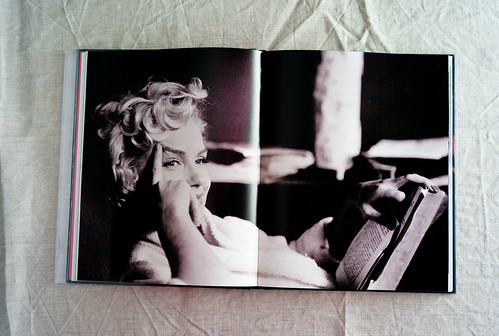
In the book each final print is paired with it's contact sheet. Shown above is Elliott Erwitt's photograph of Marilyn Monroe. You can see his selection process right on the contact sheet; marking the frames he likes and picking those to enlarge. Final selection would of course be made from the enlargements. As you see, the picture marked as "#1" wasn't the final pick.


I just wanted to show a 'contact sheet' from a large-format photographer too. Much of early large-format photography was only ever contact-copied, although it obviously holds up to much greater enlargements than 35mm does. But you get to see two alternative views of the famous photograph of "Case Study House #22".


Each photograph is accompanied by a brief biography of the photographer and an equally brief story about the photograph. In case you don't read the Queens, it is also provided in French, German and Spanish. It is a nicely bound book, with good quality paper and quite decent reproductions. Its main features are the range of photographers, 44 in total, and the insight into their work you get from seeing all the pictures they didn't pick.

Wednesday, July 21, 2010

Small Trades by Irving Penn


The well known Vogue photographer Irving Penn, didn't exclusivly shoot the famous, the pretty and the nude in the world of high fashion. From the beginning he was a still-life photographer. He did a large series of portraits of more common people with the implements of their trades. From the start it was a feature for Vogue about the workers of Paris, but he continued long after that. The entire series is 252 portraits and was bought by the Getty museum in 2008. The Getty is also the publisher of the book.


The book is quite hefty and very well made, with heavy, luxurious paper. In the beginning there is an example contact-sheet with some slight variations of the pose of the subject, and some pictures from the back. That way one can get an idea, if only a slight idea, how he worked. There is also a picture of his Paris studio with a large window on the wall and one in the ceiling. In addition, he has a reflector and a mottled back-drop, but that is it. It looks positively frugal by today's measure.


The pictures as such are reproduced in outstanding quality. They depict, apparently, comfortably posed workmen and women with one or two tell-tale tools that they use in their work.


It is a brilliant book for anyone interested in photography in general or in portraiture in any medium.

Julius Shulman in Modernism Rediscovered


I am in the middle of my one-week vacation. That means I try to do some photography. While trying to find some inspiration for doing that; I found some new (for me) photo-books. A perfect combination of activities becomes photographing photo-books and writing short reviews.


First out is Modernism Rediscovered, which is a book about the modernist movement in American architecture; And photographs by Julius Shulman. One of the big names in photography and one of the very best know architectural photographers ever. His probably best known picture is the "Case Study House #22, Los Angeles, 1960. Pierre Koenig, Architect." Which you can see below (It is from 'The Contact Sheet', another book that I will come to shortly):


I had of course seen his photos before, but it wasn't until recently I found out who took them. There is a film about his life and photography called 'Visual Acoustics'. It inspired me to set out to find a matching book. Luckily it turned out that Taschen has one. Not only do they have one, it has a special-price edition. Very affordable. Very high quality. Very good reproductions.


And if you are interested in architecture as such, there seems to be a wealth of information in the text. =)

More to come.

/Michael