Showing posts with label cooking. Show all posts

Friday, July 26, 2013

Newton's law of cooking chicken

Newton's law of cooling can be used to predict the time of death from the temperature of a corpse and the ambient, which is a silly and boring example. On the other hand, when we are cooking chicken and our better half asks when it will be done (and demands that it be done in a given time), then it becomes an interesting and useful equation. Let us say that it has already cooked for almost an hour, it is around half past seven, and dinner is supposed to be at eight.

The important point is that Newton's law of cooling is equally applicable to cooking because physical law is symmetrical, which means that cooling and heating behaves the same way. The law states that the rate of change of the temperature of an object is proportional to the difference between its own temperature and the ambient, or
dT(t)/dt = -k(T(t)-Tambient)
where T is the temperature of the object, t is time, k is a constant, and Tambient is the ambient temperature. It is a differential equation that solves to 
T(t) = Tambient + (T(0) - Tambient)e-kt
which we can use to calculate the temperature we have to cook the chicken at to be able to serve dinner at eight(-ish). The only problem is that we have to know the constant k which is specific to the particular chicken and filling we have in the oven. Luckily, we used an oven-thermometer, and we kind of remember how long it has cooked already. So, if it took 50 minutes to go from 10°C to 53°C with the oven at 150°C then we can calculate the constant as
k = -1/t ln((T(t)-Tambient) / (T(0)-Tambient))
that is
k = -1/50 * ln((53-150)/(10-150)) = 0.0073 min-1
In turn, we can use this to calculate what temperature we have to use for the chicken to be done in another 30 minutes as
Tambient = (T(t) - T(0)e-kt) / (1 - e-kt
 which gives
Tambient = (80 - 53*e-0.0073*30) / (1 - e-0.0073*30) = 200°C
Luckily, we didn't have to do the calculations by hand because a bigger nerd than us have created a web-app where we just plug in the known values and get the missing one for free.

Finally, here is the money-shot.
Science, because it works bitch.

(Although the higher temperature did burn the skin a little bit, and it would have been jucier if it had cooked at 150°C the whole time.)

Monday, November 05, 2012

First Floor

Finally some days off coming my way. Spent three days in Berlin at Hotel Palace, a really posh place. Morning and evening turn-down, including one-time slippers placed on a napkin (sic) by the bed. Nice spa, excellent breakfast, and the first-floor Guide Rouge star-restaurant: First Floor. No one would call it cheap, but very posh with polished wood-panelling, a total of eleven tables (whereof three were occupied on this Wednesday night), waited on by five waiters.

Some kind of olive-oil appetizer, very strange, but excellent.

Cracker with dill and some other stuff. Also an un-ordered appetizer that was excellent.

The six-course tasting menu with six selected wines was really good. As is common in these, posher, establishments, six-courses turned out to mean nine, and pralines for the coffee. 

Dove-filét with sauce, a light foam of something and some stuff on the side. Just brilliant.

Then, on Thursday, we went to another place with South-german food and wine. Very much simpler, although not in a bad way. A quite rustique atmosphere, small bare-wood tables and at least two booked sittings per night. They actually asked us to leave to be able to seat the next group. So, popular, and very good.

Friday morning I broke my two-day vacation streak with a meeting at the lab of a couple of my collaborators. After that we ate lunch at another rustique but Italian place, right under the rail-way. More brilliant food, I miss Berlin already.

Sunday, April 08, 2012

Beef-salad


One dish I have quite recently gotten to enjoy is salad. It is almost never done well at restaurants, and it is hard to do well in Scandinavia. It is getting better, but you can still only get really good, sun-ripened vegetables for a short period in the early autumn. Otherwise you have to buy your vegetables and let them lie for a week or so.

Now, the beef-salad is one of my favourites, you can do it with any meat, but prime, well-hung beef is just unbeatable. It is best served on plates, but you can equally well mix it in your salad-bowl and just put it on the table.

First you need some bitter lettuce. Today, I used ruccola, but finely-sliced endives are another brilliant choice. If you don't like it bitter, you are wrong may like it better with some baby-spinach. You can also add fresh herbs, for example basil. A less bitter choice may be a good idea if you are having wine, especially good red wine, to drink. The bitterness has a tendency to overpower the tannins and make the wine taste like juice.

Then you need ripe tomatoes. Best are the ones you watch fall and then use directly, but you can just buy your tomatoes and leave them to ripen on your counter for a couple of days and it will be almost as good. Watch out for really unripe tomatoes, they go powdery and soft before they get sweet and juicy.

I often use some peppers, red in this case, to get that crunchy feeling. Lately I have also started using Spanish pepper or mild jalapeno to get some extra sting. Olives are important, and they have to be good quality olives. There are any number of types, the green ones I used today were Greek Halkidiki olives.


I added an Italian air-dried ham, just because I could. Not Parma, but quite good anyway. There should always be cheese in a salad. I almost always use Parmigiano Reggiano, but Grana Padano is also good or Västerbotten, the only Swedish cheese worth its name.

Once you have built your salad, then you cook the beef. Rare to blue. Slice it, and spread it over the top of the salad. Finish off with a large-bodied olive oil and a liberal amount of Aceto Balsamico di Modena. Observe that I have never spent too much on a Balsamic Vinegar. They just keep getting better the more you spend.

Serve while the beef is still warm.

Saturday, August 14, 2010

Fillet of horse sous vide


It has been kind of hectic lately, finishing the thesis, preparing for the dissertation, getting a mortgage for buying a new place to live in Sweden, working full time in the cardiology department and revising two papers.

Anyway, my fiancée got a job on Wednesday and by Friday we had outbid the competition for our dream-apartment. Or, a nice apartment anyway. So, today we were celebrating. She brought a Veuve Clicqout Ponsardin from the air-port and I went to the butcher's and got a slice of horse's fillet.


Horse is a dark, game-like, meat. Like any red meat it shouldn't be cooked to harshly, and this was so tender that I accidentally put my thumb through it when I was preparing it. So, cooking with care was the order of the day.

I have been reading a lot Cooking Issues since I was made aware of it. It is a fantastic cooking blog, especially if you are scientifically minded. Anyway, they do sous vide (eng. under vacuum) cooking, which is slow cooking with a twist. You vacuum-pack your uncooked food and then cook it in a water-bath at the desired temperature (58 centigrade for medium rare beef) for an hour or two.


First, I seared it quickly with salt and pepper.


Since I don't have a vacuum-pump at home I just packed it in a plastic bag with red onions and garlic, sucked all the air out, and put it in a pot with water in the oven. The goal temperature is 58 centigrade for medium rare. Sadly my cooking thermometer is broken and the oven temperature dial is not as accurate as I would wish. Thus, I checked the temperature the old fashioned way, 58 is hot enough to hurt, but not scalding. I put a small weight on top to keep it under. It was allowed to cook for about two hours. Then I seared it once more and served directly.


The temperature wasn't exact enough and we ended up with a medium cooked piece of meat. It was a very tender, fantastically juicy and tasty piece of meat though. Any time now, I am going to buy a proper heater/circulator like the Sous vide professional, which is made especially for cooking sous vide. It does look very much like your standard scientific water-bath heater/circulator and that is because it is. Although, they have a prettier, black, casing for the cooking variant.


If you have meat, you need potatoes. In this case a spring potatoe & melon salad. The sweetness works fantastically with the dark horse-meat and the champagne.


For a sauce I made a classic reduction of assorted vegetables and the juices pressed out of the meat during cooking. I reused the root-vegetables to make a purée, nothing much by itself, but adds a nice extra texture to the meal.


Here are the vegetables, the rosemary and the juniper-berries before they were transformed into stock with the help of some gin and a lot of water.


And there we are: Horse-fillet sous vide with mashed celeriac and turnip. A potato and melon salad, sauce and champagne. I served it with a little balsamic syrup to add some acidity.

Saturday, January 09, 2010

Beef with some stuff, some sauce and pasta

Here's the much awaited (by all of my about zero readers) nephrophysiologist cooking column.

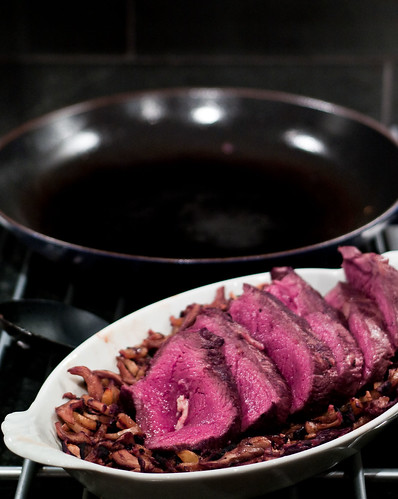
Rochefort stuffed roast beef on a bed of oyster mushroom, celleriac and turnip, with a hot balsamic vinegar sauce and spaghetti.


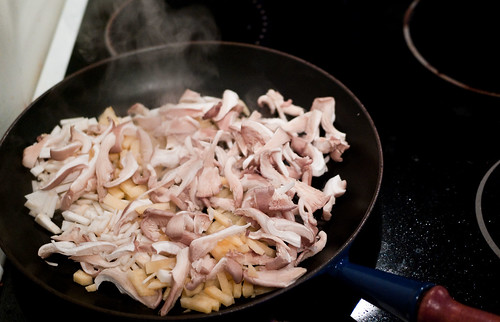
The vegetables were fried in butter with a drop of black truffle oil. Then the beef was fried in butter, peppered and salted, and allowed to rest for a minute before it was stuffed with all the Rochefort I had available, and some other similar cheese that was found in the refrigerator.

The vegetalbles and the beef were put in a dish and covered with foil and cooked for an hour and a half at just above a hundred degrees centigrade. The last 15 minutes the temperature was turend up and the foil removed to get some proper heat into the outerpart of the beef.


Spaghetti was boiled in salted water.

For the sauce, the bottom of a small pot was covered with sugar, which was melted. As the sugar started turning brown balsamic vinegar was poured in. Nothing too fancy, just your ordinary bulk balsamic vinegar. To this was added some hot chili and ground white pepper, veal stock, and quite a bit of cream. It was then allowed to boil for a while, and some more butter was added before serving. Don't boil it too long, it'll turn into caramel.


The butt-ends weren't fit for human consumption and were given to the dog. It was served with a cheap Danish beer while watching The Hunt for Red October.

/M