Sunday, June 05, 2011

Conspiracy against science

This is a warning to all scientists out there (and anyone else who has too much control over their working hours). Stay away from Minecraft! I first found out about it through the online comic xkcd that published an excellent strip about policy makers, the media and science, or as I like to call it: Stay away from the green jelly beans!

Since I always do what xkcd tells me to. I immediatly tested the old version of Minecraft, which is free, and then bought the beta. Yes, it's still in beta and yet they have over two million paying users.

The home page describes it as:
"Minecraft is a game about placing blocks to build anything you can imagine. At night monsters come out, make sure to build a shelter before that happens."
Which describes the pretty well. Depending on your imagination and persistence you can build anything, it's like LEGO that way. You can either go the drug-induced but orderly xkcd-way, or you can go all out crazy and build a scale model of the USS Enterprise (that's United federation of planets Star Ship Enterprise in case you thought anything else). The other way to go in the SF - Fantasy spectrum would be a recreation of Tolkien's Middle Earth, but no one could be that crazy, or could they?

The alternative is to play the survival mode, where monsters come at night. It starts all peaceful with sheep and cows milling around in a serene, sun-lit landscape. Then the sun goes down leaving the world pitch dark, and then the monsters come. First you hear the clacking of bones, or the groaning of zombies, and then you die. If you know this you build a house and light it with torches before night comes, then you are safe.

By the way, parents of small children don't always appreciate your explaining this aspect of the game to their children. Apparently it makes them afraid of the dark, or makes them excitedly tell their younger siblings that the monsters come at night, which amounts to the same thing.

So, that's about it.

Man modestly mines minerals.
Moonlight marks midnight.
Man-eating monster mangles.
Mutinously mutes machine.
Mired mind must muster motion.
Meets miserable methods-mountain.
Meekly manages more Minecraft

Thursday, May 12, 2011

Two-season country

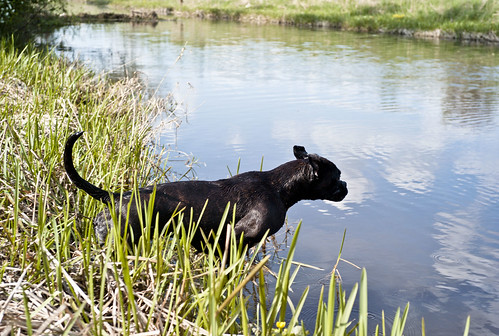
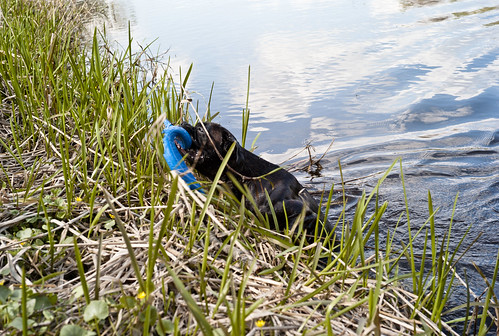
Sweden has apparently turned into a two-season country. A month ago it was still below 10°C in the day and frost at night. Now it is 28°C in the shade and too warm to live in the sun. There is only one thing to do: Skip work during the day and bring the dog down to a local stream.


She has completely lost all respect for water now. If it looks wet (and there's a frisbee), you can just jump right in. If the bank is too high to get up, then that is a problem for later.


Once home again she goes to sleep, I surf on facebook and blog until sundown, and then; then I continue working on my grant. It's due Monday, so there are oceans of time.

Monday, April 18, 2011

Return to the Dark Side

In 1984 my father brought home our first computer. From the year you should be able to guess what it was. In '89 my most used system changed to the new Good Guys(TM): MS-dos, later know as the Bad Guys(TM): M$-Windoze. Being able to play better games was the main reason for that change. Later, 1995 or so a friend brought some disks he had got of a BBS with something called GNU/Linux. For the next ten years I used Linux almost exclusively, including my early years at university and in my research. However, it eventually became apparent that you cannot do research on Linux alone. You need Microsoft Word, and you need EndNote. In addition, you would rather like to have Adobe Photoshop and Illustrator as well.

For years I either double-booted with both MS-Windows and Linux, or, had several computers in parallel. The idea was to have one for heavy work, like statistics and dual-boot it for Windows-programs like Word and Photoshop. Then another computer for most other things. This other computer would run Linux only and be quite small, a netbook, as they later became known as. The result was that I had to bring both computers most of the time. That was a good idea that turned out horribly wrong.

I didn't consider Apple for years, it was expensive, didn't run games and wasn't GNU (If you don't know why that matters, just ignore it). Then I bought a iPhone 4, upgrading directly from a phone with buttons that could send SMS and make phone-calls (Yes, I am a late adopter). And it was slick. As slick as I remembered thinking the Apple Macintosh Plus was in its time. It was easier to check mail with the iPhone than to use the computer. One thing led to another, and yesterday my 13 inch MacBook Pro arrived.

That's enough personal history for one post. The rest is the mandatory setup-story: How to migrate from Linux/Windows dual-boot with Linux-on-the-side to OSX Snow Leopard.

All my old files were easily copied by way of a couple of 1TB USB hard-drives. The hard part was consolidating the three different versions of the project-folders from different computers. For file-organization I opted to keep my age-old folder hierarchy and using the Desktop-folder as root so that I get easily accessible icons. Basically, I have a "job" folder for work-related stuff, and a "div"-folder for other stuff. I then linked the Pictures, Download, Documents, Public and Dropbox folders to the desktop as well. In bash and emacs it makes for a longer path (/Users/user/Desktop/job vs. /home/user/job), but otherwise I think it will be easier.

The Apple backup-facility: "Time Machine" is a dream to setup. It needs no explanation, just use it.

Email was easily imported as mbox-files and, I guess, most other formats too. It automatically handles gmail, appropriately compared to other accounts. It is well built and apparently handles my 15000+ mail-archive without any particular complaints.

Syncing with my iPhone got all my contacts and calendars automagically transferred. Brilliant.

Adobe programs are in essence designed for aApple so they pose no problems, so far. I got CS5 Design Premium to get Illustrator, Photoshop and Bridge (the rest are a bonus). Note that image analysis functionality only is included in Photoshop extended, thus Premium.

MS Word, Powerpoint and Excel are necessary. The Apple variants Pages, Keynote and Numbers are probably nice, but from experience the compatibility is not good enough. I got Microsoft Office 2011.

Then the problems started. EndNote X4, does not work with Word 2011 under OSX. You have to update to 4.0.2, and activate Cite-While-You-Write again in EndNote "Customizations". This may be enough but you might have to copy the "EndNote CWYW Word 2011.bundle"-subdirectory from the CWYW subdirectory to the Word Startup directory in the Office directory. And, then you have to activate the Startup directory for Word under "Preferences - File locations".

(If you didn't know what GNU was earlier, then you can stop reading now. The rest is qualified nerdery.)

One fantastic thing, which I hadn't realized, is that OSX uses proper movement-bindings by default. C-f, C-b, C-n, C-p, C-a, C-e etcetera move the cursor as they should. As usual the Microsoft applications do not conform by default, but it can be fixed. In Word open "Tools - Customize Keyboard" and look for EndOfLine, StartOfLine, LineUp, LineDown, CharLeft, CharRight and EditClear. You have to look under "All Commands", but you can type the first few letters to search. Then just add the proper bindings. Even C-k can be made to work by selecting "Tools - Macros" and creating a new macro with the lines:

Selection.EndKey Unit:=wdLine, Extend:=wdExtend
Selection.Cut

Put them just before the "End Sub" line. Then you go back to Customize Keyboard and set your key-binding.

Emacs is always a bit of a chore to install on any new system. You have to get your bindings just so, and get all your local enhancements to work as they always have (emacs-users are conservative that way, not like the insanely fundamentalist vi-users, but still). The first thing to do is always (setq inhibit-splash-screen t). The splash-screen is a Bad Thing(TM). Then the best way is to use the Apple command-key as Meta since the Macintosh uses both Alt-keys for character-bindings, i.e.

(setq mac-option-key-is-meta nil)
(setq mac-command-key-is-meta t)
(setq mac-command-modifier 'meta)
(setq mac-option-modifier nil)

Today OSX (and most good systems) use UTF-8 as the default character coding system. You can make sure that this works by setting

(set-terminal-coding-system 'utf-8)
(set-keyboard-coding-system 'utf-8)
(prefer-coding-system 'utf-8)

I found the easiest way to install packages was to just place them in my user's site-lisp directory and use load-path for each one. The user site-lisp directory is: "~/.emacs.d/site-lisp/". Then I pretty much copy-pasted my old .emacs and everything seems to be working splendidly.

Caps-lock is Evil, the button to the left of "A" should be a control-key. Luckily, you can change your modifier keys under "System preferences - Keyboard - Modifier Keys".

I end with a short note of thanks to those who wrote the web-pages and manuals where I found many of these hints. I'm sorry to say I didn't save the references while I did the setup, so I have no idea where I stole the ideas from.

Sunday, March 27, 2011

The Swedish nationals in grantsmanship

In Sweden the big-game funding season just ended. April 6th was the deadline for Science Council (Vetenskapsrådet, VR) applications. For most scientists in Sweden this is commensurate to NIH funding for the medical sciences in the US. It is something you can use to introduce yourself and gain instant credibility, as in: "I'm a VR-funded scientist." Implying, of course, that such a scientist is better than the other kind. In this case the other kind often agrees.

When writing a VR application there are three important questions to answer: Why the project? Why you? and, Why at your department?

The first is kind of obvious. If you want money for doing something then you have to show that doing it is interesting, important and not impossible. Avoid double negations though, natural science reviewers value clarity over alliteration.

The second is easy to under-do. 'Aren't my papers enough?' you might ask. The short answer is: no. You have to make sure to cite your own data in the background, your reviewers shouldn't have to look for it. And yes, your previous work should be made to look central to the field, how could you possibly know anything about it? Then, the preliminary data is another large part of the 'why you'-question. It is where you show that what you propose is actually feasible, for you.

The third: 'Why at your department' is sometimes tricky. It is seldom the case that there is only one obvious place for a project to be done. However, it has to be absolutely clear that a given project is possible at the department of the applicant. Make it obvious that the project is suited for your place of work, and tease out something that makes it a really good place for the proposed research.

Foremost in your mind should be that reviewers are subtle and quick to anger. This means that your proposal should formally impeccable; no spelling errors, no fancy punctuation and no awkward alliterations. Further, there should be no claims that runs the risk of not being believed, or claims that has to be checked. The funding asked for should be something that the agency could reward; don't ask for too much, and, just as importantly, don't ask for too little. Finally, be short and to the point. There should be only one aim, and it should be clear as the vitreous humour of a hawk.

Anyway, that's a short summary of the advice I have been given while writing my application these last few weeks. Now I only have to wait six months before the awarded grants are announced in November.

Sunday, February 13, 2011

Non-report from the scientific meeting of the Norwegian Hypertension Society

In the Norwegian Hypertension Society (no: Norsk hypertensjonsforening) we have two major events: The CME-course on hypertension, and the scientific winter meeting. They are held every other year. As the secretary I have been holding all sorts of strings: announcements, registration, and such. Then I was supposed to lead a session and hold a presentation, and finally I was going to meet old friends and collaborators and have good time. All in all it was supposed to be a brilliant meeting.

Then a snow storm hit the Uppsala-Stockholm region. My taxi was 20 minutes late, but that turned out not to be a problem because boarding was 30 minutes late. After spending almost two hours on the airplane we were told that the flight was cancelled. Re-booking was impossible, there were 300 people before me in line. Just buying a new ticket on line didn't work. I tried probably ten or fifteen times and it always said that the ticket couldn't be booked.

Anyway, I heard that the meeting was a success. We had the honour of the first presentation of the Scandinavian Candesartan Acute Stroke Trial (SCAST) by Else Sandset. They showed no benefit of strict blood pressure control after acute stroke. It was published the same day in Lancet. This was by no means the only exciting new finding presented, but I shan't bore you too much.

After the scientific meeting there followed the annual meeting of the society where I stood for re-election. I got to continue as secretary in spite of not being there and having moved back to Sweden. Then I missed the dinner.

All this followed last year's failure to hold a CME-course in Trondheim because of the eruption of a volcano on Iceland.

How un-lucky can you be, really?

Sunday, December 19, 2010

Death is loosing out

Originally, Death on his pale horse, was the undisputed leader of the Apocalypse. Lately, however, the general feeling is that he has been usurped by War. Today, we have the honour to present indisputable evidence that this is the case.

Google Ngram Viewer (Thanks to David McCandless at Information is Beautiful for pointing it out to me) is an interactive histogram that plots the frequency of words in Google Books from 1800-2000. On the plot below, you can see that Famine and Pestilence always were part of the chorus while Death had the lead in the duet between him and War. Around 1850, War suddenly found his true voice and overtook Death. From about 1814 he seems to have gone on a solo tour leaving the rests of the Horsemen behind.


We should let this warm our hearts, even though War is topping all the charts, Death does not ride with him, and the Horsemen are certainly not going to Ride Forth any time soon. This is corroborated by statistics of actual war deaths. Not when you look at the number of people killed, but when you look at how many people die of war as a proportion of the population, or how big a proportion of the population will die in warfare.


This is a figure from "War before civilization" (fig 6.2, pg. 90) that I borrowed for educational purposes from a presentation I found on the internets. Can't remember where. Anyway, what it shows is that 20-60% of the male population dies at war in present-day and pre-historic tribal societies. The same number for the western world in the war-ridden 20th century is well below 3%. That includes both the World Wars. What it means is that modern wars only directly effect a small part of the population. We all have to watch it, but that isn't as deadly.

In short, the world is much more peaceful than it seems, and certainly much more peaceful than it ever was. In 2008 the rate of violent death, as in murder or assault, for men was 1/100000 and 1/200000 for women. So, even though War is gaining in popularity Death is loosing out. And no one has seen Ronnie Soak for years.

Wednesday, September 01, 2010

Physiology on the sub-way map of science

By way of Chad Orzel and Derek Lowe I came upon Crispian Jago's wonderful sub-way map of science. While he actually presents his quite fantastic map as : "500 Years of Science, Reason & Critical Thinking via the medium of gross over simplification, dodgy demarcation, glaring omission and a very tiny font," I have to take umbrage for physicians and physiologists everywhere. Albrecht von Haller wasn't the only physiologist who did anything in the 18th century, and I think we existed, at least partially separate from "Natural History" in the 16th and 17th centuries. Above all, the science of Medicine certainly did not turn into "21st Century Microbiology!"

How, then, should this be put right?

Well, with a blog-post obviously. But first microbiologists deserve a line of their own, even if it will intersect with the line of medicine in quite a number of places. This is their problem. The medicine-line should be renamed "Medicine and Physiology", neurology is either a medical speciality or a branch of physiology. It could, of course, be argued that neuroscience/neurology/psychology should have a line of its own, but I leave that to the neuroscientists.

The freed-up line called "Medicine and Physiology" should start at Vesalius. Unless you want to go back to earlier times. Given the extent of the map, it may be wise to stop at the 16th century.

Hooke, Harvey, Malpighi and some others should be included on this new line. Now to the additions:

16th Century
  • Paracelsus (founding father of toxicology and early enlightened surgeon who suggested that wounds shouldn't be cauterised).
  • Bartolomeo Eustachi (One of the first anatomists, although his work wasn't published until 1714: Tabulae Anatomicae).
  • Ambroise Paré (1545: Wrote the first non-Latin/Greek textbook in surgery and was one of the original great experimentalists in surgery).

17th Century
  • Olof Rudbeck (1651: described the lymphatic circulation).
  • Lorenzo Bellini (1662: Exercitatio Anatomica de Structura Usu Renu).

18th Century
  • F. Pourfois du Petit (1727: shows vasodilation in the eye following denervation).
  • Stephen Hales (1733: Haemastatics).
  • Giovanni Mrogagni (1761: The seats and causes of disease).
  • John Hunter (1794: A treatise on blood, inflammation and gun-shot wounds).
  • Alexander Schulmansky (1783: De structura renum).

19th Century
  • Hanaoka Seishu (1804: first known use of anaesthesia).
  • Charles Bell (1811: sensory and motor nerves).
  • Richard Bright (1827: renal disease and oedema).
  • Jean Louis Marie Poiseulle (1828: measures blood pressure, 1841: fluid dynamics in small tubes).
  • William Bowman (1842: On the structure and use of the Malpighian body of the kidney).
  • Carl Ludwig (1842: describes glomerular filtration as physical forces).
  • Emil du Bois-Raymond (discovers the neural action-potential).
  • Adolf Fick (1855: describes law of diffusion that bears his name, and later used it to measure cardiac-output).
  • Karl von Vierordt (1855: measures the arterial pulse pressure).
  • Jakob Henle (1862:Described the loop of Henle's, and together with Robert Koch formulated the "Henle-Koch postulates").
  • William Gull (1872: microvascular disease).
  • Camillo Golgi (Described large parts of the nervous system and received the Nobel Prize in 1906. In addition he described how the distal tubule returns to the originating glomerulus, an important finding in kidney physiology).
  • Scipione Riva-Rocci (1896: Presented his method for measuring blood pressure, which is still used today).
  • Robert Tigerstedt (1898: showed the existence of Renin the first identified hormone).

20th Century
  • Victor Henri (1901: Describes the Henri-Michaelis-Menten equation for enzyme kinetics).
  • Leonor Michaelis and Maud Menten (1913: provides their insight on enzyme kinetics).
  • Ernest Starling (Describes the exchange of fluid over the capillary membrane in the Starling equation, then goes on to describe the Frank-Starling law of the heart, and then goes on to describe the idea of hormones).
  • Otto Frank (Describes the Frank-Starling law of the heart).
  • August Krogh (Treated diabetes with insulin).
  • Ewald Hering (1924: Discovered the baro-receptor and their role in blood pressure regulation).
  • Joseph Wearn & Alfred Richards(Establishes glomerular ultrafiltration as described by Carl Ludwig by micropuncture).
  • Werner Forssman (1929: performs the first human heart catheterisation, on himself).
  • Homer Smith (Describes the nephrons as autonomous working units in the kidney, and much more).
  • Harry Goldblatt (1934: Establishes the first experimental model of hypertension).
  • Arthur C. Guyton (1955: proposes that cardiac out-put is governed by periferal resistance, measures interstitial pressure and shows that it is negative, and goes on to show how the kidney regulates blood pressure).
  • Carl Gottschalk (1959: shows that the concentrating mechanism in the kidney is dependent on a counter-current system).
  • Edward D. Freis (1960: presents the first ever double blinded, controlled clinical trial).
  • Robert Furchgott (1980: Discovers the endothelial derived relaxing factor, and goes on to show that this is nitric oxide in 1986).

And then there are any number of still living physicians and physiologists who could be included.

Before it, in the end, turns into "21st Century Medicine and Physiology" and nothing else.

At least, that is the view of a nephrophysiologist. I know. There are physiologists and physicians who aren't into kidneys, but I always try to have hope: They will convert in the end.